Insurance renewal reminders: workflow, templates and metrics
Insurance renewal reminders work best when they help customers review their renewal, ask questions and complete the next step. Build the workflow around current policy information, a useful message sequence and a clear route to your servicing team. Stop or change the sequence as soon as the customer's situation changes.
Key takeaways
- Give each reminder a different purpose: introduce the renewal, invite questions or help the customer complete the next step.
- Treat a reply as a conversation to handle, not simply a reason to send another reminder.
- Recheck policy status before each send so customers who have renewed leave the sequence.
- Use AI for routine questions and routing; bring an authorized person into advice, disputes and exceptions.
- Measure completed renewals alongside unresolved questions, delivery and opt-outs to understand where the process needs work.
What is an insurance renewal reminder workflow?
An insurance renewal reminder workflow connects a policy’s renewal date to a series of customer communications and follow-up actions. It determines who should receive a message, what the message should help them do and what happens after they respond.
A scheduled reminder can announce a date. A workflow also handles the next event: a question, a request for an advisor, a completed renewal or a change in contact preference. That is what makes it useful to both the customer and the servicing team.
Why another reminder may not solve the problem
Imagine a customer reading a renewal message between meetings. They notice the date and decide to look at it later. A week passes, another message arrives and they still have the same unanswered question about the premium.
Sending again has not made the next step easier. The customer needs an explanation or a conversation before they can decide what to do.
This is where renewal communication can break down. A message supplies a deadline but leaves the customer to find documents, locate the payment process or work out whom to ask. Meanwhile, the servicing team sees an incomplete renewal without knowing what is holding it up.
Design the sequence to make those obstacles visible. Each message should offer one clear action and a simple way to ask for help.
How the workflow works
Start with the policy system as the source of the renewal date and current status. Add the customer’s permitted contact channel, the approved message content and the team responsible for handling replies.
The sequence then follows these steps:
- Identify an eligible renewal. Check the policy’s date, status and communication rules.
- Send the appropriate message. Match the message to the stage and the customer’s previous response.
- Read the outcome. A reply, confirmed renewal and failed delivery each call for a different action.
- Continue, route or stop. Answer a routine question, assign a request to a person or remove a completed renewal from the sequence.
- Recheck before the next send. Use current information rather than the snapshot taken when the sequence began.
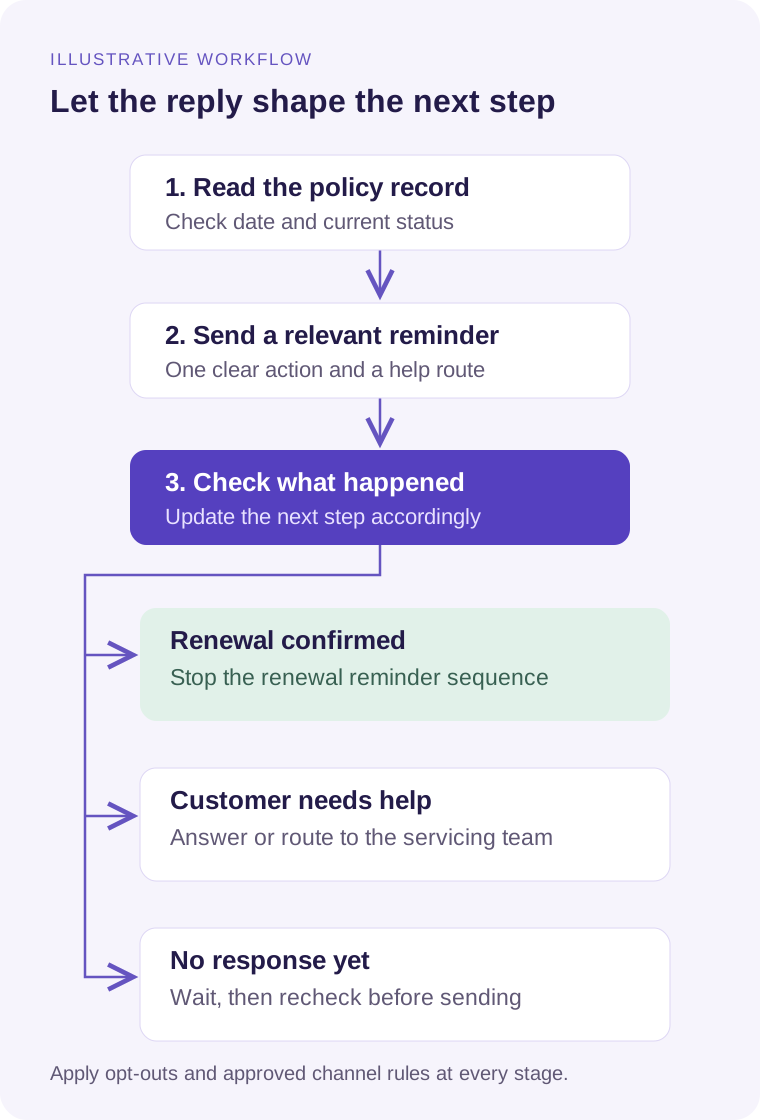
Illustrative workflow. The reply and policy record determine the next action; the calendar alone does not.
For example, a customer who asks to speak with an advisor should move into that conversation. Sending a generic “Have you renewed yet?” message while the advisor is investigating the question makes the process feel disconnected.
An example renewal sequence and message templates
The following schedule is an illustrative starting point, not a prescribed industry cadence. Adapt the timing to the insurance product, required notices, customer preferences and your servicing process.
| Example timing | Message purpose | Customer’s next step |
|---|---|---|
| Around 30 days before renewal | Give the customer time to review | Open the renewal details |
| Around 14 days before renewal | Invite questions that may be holding things up | Reply or request assistance |
| Around 7 days before renewal | Help a customer reach the right person | Arrange an advisor conversation if needed |
| Near the renewal date, where appropriate | State the verified date and available action clearly | Use the approved renewal process |
You do not need to send every stage to every customer. A confirmed renewal ends the reminder sequence, while an active servicing conversation may require a pause or different follow-up.
First reminder: make reviewing easy
Hello [name], your [policy type] renewal is due on [date]. You can review the renewal details in your account at [approved link]. If you need help finding the documents, reply here.
This gives the customer a manageable first action. They can review the information before deciding whether they need help. Replace placeholders with verified details, and keep sensitive policy information inside the insurer’s appropriate authenticated service.
Follow-up: invite a useful reply
Your renewal is due on [date]. Have you been able to review the details? If you have a question, tell us what you need help with and we can connect you with the servicing team.
Replies such as “I have already paid,” “I cannot open the link” and “Why has the premium changed?” reveal different obstacles. Use the reply to select the next step instead of restarting the same message sequence.
Advisor request: prepare the conversation
I can request a conversation with an advisor about your renewal question. What time would suit you, and which contact method would you prefer?
Pass the question and preferred contact details to the appropriate team. If you are collecting a callback request, describe it as a request until the team accepts or confirms it. These examples are drafting patterns; the insurer should approve the final wording and channel use.
Choose the right level of automation
The workflow does not need AI at every step. Date checks, eligibility rules and stopping conditions are usually defined business logic. AI can help interpret varied replies and answer routine questions from approved information.
| Approach | Best suited for | What still needs attention |
|---|---|---|
| Scheduled reminders | A straightforward notice with a fixed next step | Current status, delivery and opt-outs |
| AI-assisted conversation | Customers ask routine questions in different ways | Approved knowledge and a clear route to people |
| Advisor-led follow-up | Advice, disputes or decisions requiring authority | Assignment, response expectations and conversation context |
These approaches can work together. A scheduled message can start the conversation, an assistant can help locate documents, and an advisor can discuss a question that needs professional judgment.
Set up your first renewal workflow
- Choose one policy group. Start with a renewal process the team understands and can review. Avoid combining unrelated products with different servicing requirements in the first sequence.
- Map the required information. Identify the source of the renewal date, status, contact permissions and responsible team. Decide how the communication system learns that a renewal has completed.
- Prepare messages and reply routes. Write the initial reminder and follow-up, then decide what happens for document requests, payment problems, advisor questions and opt-outs.
- Assign the receiving team. A callback request needs an owner and an accurate response expectation. Include the customer’s question so they do not have to begin again.
- Walk through representative cases. Use test records for a completed renewal, a customer needing help, a failed delivery and a delayed status update. Inspect the resulting messages and assignments.
- Introduce the sequence to a limited group. Review replies and unfinished cases with the servicing team, then adjust the wording or routing before expanding.
This sequence gives you something concrete to improve. If customers repeatedly ask where the documents are, make the access instructions clearer. If advisor requests wait too long, fix ownership or capacity rather than adding another reminder.
Common problems and how to handle them
| Problem | Why it happens | What to do |
|---|---|---|
| A renewed customer receives another reminder | The sequence uses an old status snapshot | Recheck the authoritative record before sending and reconcile delayed updates |
| A customer replies but nobody follows up | The campaign tracks replies without assigning work | Route the request to an owner and monitor unaccepted cases |
| Customers ignore repeated messages | Each message asks for the same action without resolving an obstacle | Give stages different purposes and offer a help route |
| A payment problem becomes a coverage question | The conversation crosses from administration into a consequential decision | Send it to an authorized person with the relevant context |
The insurer should review communication and data handling for its jurisdiction. The NAIC’s overview of AI in insurance provides US oversight context; it is not a substitute for reviewing a particular deployment.
Measure the journey from reminder to renewal
Start with eligible renewals and follow the customer journey through delivery, replies and completion. Add unresolved questions, opt-outs and complaints so the report shows where customers need help.
| Measure | What it tells you |
|---|---|
| Delivered messages ÷ attempted messages | Whether the contact channel is reaching customers |
| Customers who reply ÷ customers reached | How often the sequence starts a conversation |
| Completed renewals ÷ eligible renewals | The renewal outcome for the defined group |
| Unresolved requests and their age | Where servicing work remains open |
| Opt-outs and complaints | Whether contact frequency or relevance needs attention |
Suppose an illustrative group contains 200 eligible policies. Messages reach 180 customers, 40 reply and 150 policies renew. The renewal rate is 150 ÷ 200, or 75%. The reply rate among reached customers is 40 ÷ 180, or about 22%.
Those are example calculations, not benchmarks. Compare similar groups and account for changes in premium, product or customer mix before attributing an improvement to the reminder workflow.
How ZINQ fits
ZINQ’s insurance workflows and follow-up capabilities are relevant to the communication around renewal: answering approved routine questions, collecting the customer’s request and connecting the conversation to a supported next step.
For this use case, the setup discussion should cover how current policy status reaches the workflow, which channels are available and where advisor requests go. Human handoff matters when the customer needs an authorized person, while connectors determine which operations the actual system connection supports.
Bring those requirements into the evaluation. A reminder is only one part of the journey; the reply, assignment and status update need to work together.
Conclusion
A useful renewal workflow makes the customer’s next step easier and gives the servicing team a clear view of unfinished work. Begin with one policy group, a relevant first message and a dependable way to handle the reply. Improve that complete journey before adding more messages or channels.
Frequently asked questions
Can I use the same sequence for every insurance product?
Use a shared structure where it helps, but review the timing, wording and servicing routes for each product. Different renewal processes may require different information or notices.
Does a renewal reminder need to include the premium?
Not necessarily. It can direct the customer to their approved renewal details. If you include a premium, use verified current information and wording approved by the insurer.
What if the customer has already paid but the record has not updated?
Route the report for reconciliation and handle subsequent reminders according to the insurer's process. Do not treat a customer's message alone as authoritative proof of payment or coverage status.
Should an AI assistant collect payment details in chat?
Use the insurer's approved payment flow. An assistant can help the customer find that route without asking them to paste sensitive payment information into an ordinary conversation.
Is WhatsApp the right channel for every reminder?
Choose channels according to customer permission, availability and the insurer's process. For WhatsApp, confirm the current messaging, consent and template requirements for the account and market before launching the sequence.
READY TO SEE ZINQ IN ACTION?
From first enquiry to conversion, follow-up and support, ZINQ helps automate the next step while keeping your team in control.
Book a DemoRelated articles
-
Real estate enquiries: an AI-assisted path to a site visit
An AI-assisted real estate journey can connect an enquiry to a viewing request by collecting preferences, checking approved inventory and coordinating the next step. Each stage needs a recorded outcome and an owner when automation cannot continue.
Pavan · August 11, 2026 · Industries → Real Estate -
AI-assisted enquiry handling for coaches and consultants
Coaches and consultants can use AI to answer approved service questions and collect information for a discovery call. Keep suitability decisions and promises about results with the professional responsible for delivering the service.
Pavan · July 13, 2026 · Sales & Conversion -
AI in insurance onboarding and claims communication
AI can assist insurance onboarding and claims communication by explaining approved steps, collecting required information and retrieving authorized status updates. Coverage decisions, settlement judgments and advice need the insurer's appropriate review process.
Pavan · June 22, 2026 · Industries → Insurance